The man below responded: "Yes. You are in a hot air balloon, hovering approximately 30 feet above this field. You are between 40 and 42 degrees North Latitude, and between 58 and 60 degrees West Longitude."
Friday, May 26, 2006
Secrets of Management
The man below responded: "Yes. You are in a hot air balloon, hovering approximately 30 feet above this field. You are between 40 and 42 degrees North Latitude, and between 58 and 60 degrees West Longitude."
Tuesday, May 02, 2006
Oil companies - Making losses or PROFITS
The issue lies not in prices but unnecessary operating expenses lavished by careless government officials. It's not the prices but the system and culture prevalent in these companies that requires change. Our largest refining and marketing company IOC, controlling 50% of the country's diesel market and 45% of the petrol market reported a loss in the third quarter. For the first nine months of FY06, net profit stood at Rs. 890 crore against a net profit of Rs. 3,998 crore for the same period in FY05. Company's director marketing, NG Kannan said,
"Indian Oil will lose Rs 5,000 crore on the sale of petroleum products, even
after taking into account government subsidies, oil bonds and cross-subsidy
payments by upstream oil companies."
Private players like Reliance, spearheaded by Ambanis have shown impressive growth in the same period eating into IOC's market share. Despite of constant pressure being put on the Govt. for price raise, I have never seen any negative figures in their balance sheets. Is this cry only fictitious to make more internal profits for the babus to enjoy? If it is real, then Govt. should insist on them following efficient, sound and proven practices to cut-cost, while learning lessons from private companies.
Sunday, March 12, 2006
Budgeting the Future
E.g. Increase in diesel prices, push's up the transportation cost and thereby increasing the prices of commodities being transported. Though FM has made an attempt on reducing the excise duty on processed food, it anyway won't affect the lower middle class. Since, they form the least population who buy processed food. FM should seriously think about it and come up with a policy that would protect them from being dejected or left out from the budget.
Saturday, March 11, 2006
Real estate greenfield - Pune
Wednesday, March 08, 2006
A job or a career?
Even today, in most homes, the emphasis is still on being educated enough to get a primary qualification, like engineering or medicine.When I hear such discussions, I remember a story I read many moons ago. In short, it was about two lads in a village.One went on to complete his education, got a job in a government organisation and was well regarded. His job, however, never excited him and he would drag himself to work everyday, coming to life only when he reached home. By his mid-forties he looked as if he were in his fifties. The second lad did not complete his education, and went on to work with a mechanic. He was not well regarded in his village.But, he enjoyed what he did. He keenly observed all that happened in the shop, interacted closely with customers and understood their issues. He also learnt to identify defects and find ingenious solutions to them. His reputation as an ace mechanic grew. He managed to set up on his own and soon collected a large clientele. Whenever anyone met him, he would be extremely cheerful, enjoying every moment of his time. In his mid-forties, he still looked thirty.So, is education about learning in the formal system or is it about learning continuously from life?
This is very true, atleast for a developing country like India where formal education is still considered a top most priority without giving a second thought to something more than that.
Thursday, February 23, 2006
What is RSS ?
RSS is the most significant advance in the fundamental architecture of the web since early hackers realized that CGI could be used to create database-backed websites. RSS allows someone to link not just to a page, but to subscribe to it, with notification every time that page changes. Skrenta calls this "the incremental web." Others call it the "live web".
Now, of course, "dynamic websites" (i.e., database-backed sites with dynamically generated content) replaced static web pages well over ten years ago. What's dynamic about the live web are not just the pages, but the links. A link to a weblog is expected to point to a perennially changing page, with "permalinks" for any individual entry, and notification for each change. An RSS feed is thus a much stronger link than, say a bookmark or a link to a single page.
RSS also means that the web browser is not the only means of viewing a web page. While some RSS aggregators, such as Bloglines, are web-based, others are desktop clients, and still others allow users of portable devices to subscribe to constantly updated content.
RSS is now being used to push not just notices of new blog entries, but also all kinds of data updates, including stock quotes, weather data, and photo availability. This use is actually a return to one of its roots: RSS was born in 1997 out of the confluence of Dave Winer's "Really Simple Syndication" technology, used to push out blog updates, and Netscape's "Rich Site Summary", which allowed users to create custom Netscape home pages with regularly updated data flows. Netscape lost interest, and the technology was carried forward by blogging pioneer Userland, Winer's company. In the current crop of applications, we see, though, the heritage of both parents.
Wednesday, February 22, 2006
Keyboard or Pen
Apart from giving a global reach to the web community it allows bloggers to publicise their area of interest without bothering much about who’s who of the readers in different parts of the world.
Given the free sites like Blogspot, Bloglines, etc,. which allow you to create blogs, and other sites providing free services like hit counter, xml feeds, blog ratings form easy ingredients for bloggers to use.
Shall this new trend of sharing information, rephrase the quote as “Keyboard is mightier than fighter jets” ? Or advancing further should we say “Blogging is mightier than nuclear weapons” ?
Sunday, February 19, 2006
What Matrix Persona Are You?
Friday, February 17, 2006
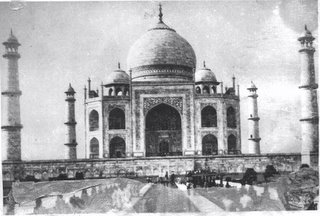
Reality of "Taj Mahal"
"The Moghul Emperor Shah Jahan in the memory of his wife Mumtaz Mahal built the Taj Mahal. It was built in 22 years (1631 to 1653) by 20,000 artisans brought to India from all over the world. Many people believe Ustad Isa of Iran designed it." This is what your guide probably told you if you ever visited the Taj Mahal. This is the same story I read in my history book as a student.NOW READ THIS.......
No one has ever challenged it except Prof. P. N. Oak, who believes the whole world has been duped. In his book Taj Mahal: The True Story, Oak says the Taj Mahal is not Queen Mumtaz's tomb but an ancient Hindu temple palace of Lord Shiva (then known as Tejo Mahalaya) . In the course of his research Oak discovered that the Shiva temple palace was usurped by Shah Jahan from then Maharaja of Jaipur, Jai Singh. In his own court chronicle, Badshahnama, Shah Jahan admits that an exceptionally beautiful grand mansion in Agra was taken from Jai Singh for Mumtaz's burial . The ex-Maharaja of Jaipur still retains in his secret collection two orders from Shah Jahan for surrendering the Taj building. Using captured temples and mansions, as a burial place for dead courtiers and royalty was a common practice among Muslim rulers.
For example, Humayun, Akbar, Etmud-ud-Daula and Safdarjung are all buried in such mansions. Oak's inquiries began with the name of Taj Mahal. He says the term "Mahal" has never been used for a building in any Muslim countries from Afghanisthan to Algeria . "The unusual explanation that the term Taj Mahal derives from Mumtaz Mahal was illogical in atleast two respects. Firstly, her name was never Mumtaz Mahal but Mumtaz-ul-Zamani," he writes. Secondly, one cannot omit the first three letters 'Mum' from a woman's name to derive the remainder as the name for the building."Taj Mahal", he claims, is a corrupt version of Tejo Mahalaya, or Lord Shiva's Palace. Oak also says the love story of Mumtaz and Shah Jahan is a fairy tale created by court sycophants, blundering historians and sloppy archaeologists. Not a single royal chronicle of Shah Jahan's time corroborates the love story.
Furthermore, Oak cites several documents suggesting the Taj Mahal predates Shah Jahan's era, and was a temple dedicated to Shiva, worshipped by Rajputs of Agra city. For example, Prof. Marvin Miller of New York took a few samples from the riverside doorway of the Taj . Carbon dating tests revealed that the door was 300 years older than Shah Jahan . European traveler Johan Albert Mandelslo, who visited Agra in 1638 (only seven years after Mumtaz's death), describes the life of the city in his memoirs. But he makes no reference to the Taj Mahal being built. The writings of Peter Mundy, an English visitor to Agra within a year of Mumtaz's death, also suggest the Taj was a noteworthy building well before Shah Jahan's time. Prof. Oak points out a number of design and architectural inconsistencies that support the belief of the Taj Mahal being a typical Hindu temple rather than a mausoleum. Many rooms in the Taj Mahal have remained sealed since Shah Jahan's time and are still inaccessible to the public. Oak asserts they contain a headless statue of Lord Shiva and other objects commonly used for worship rituals in Hindu temples. Fearing political backlash, Indira Gandhi's government tried to have Prof. Oak's book withdrawn from the bookstores, and threatened the Indian publisher of the first edition dire consequences.
From the archeological perspective to discredit or validate Oak's research, the current government should open the sealed rooms of the Taj Mahal under U.N. supervision, and let international experts investigate. But this won't be a good idea for a country like India. A situation could arise where a few religious zealots or politicians acting as religion guards will decide to destroy the Taj Mahal to restore the original temple, which may or may not exist underneath.
Sometimes its better to keep some things undiscovered for the better good of "religion", called humanity.
Tuesday, February 07, 2006
Magic 10000 - Sensex shining
But, that's not all. In days to come we could see Sensex peaking the heights of 15000. Budget will play a key role in fuelling the exchange further. Presently, country's economic policies are being designed, governed and closely monitored by the two economists, Dr. Manmohan singh (Prime Minister) and P. Chidambaram (Finance Minister). Both have earlier experience being the finance minister of the country. Mr. Singh introduced the 1991 Liberalisation policy, throwing economy open to the foreign investors when he was the FM. Mr. Chidambaram too in his last budget introduced policies, bringing common man's money into the equities.
Looking at the International market Dow, after the time of technology bubble burst, here is what Economic times reported today:
"Sensex crossed 6000, then a historic high, in the same year. But then, both the indices crashed as the technology bubble burst. However, the sensex suffered far more. Dow fell to a low of 7286 in late ’02, while the sensex plummeted to 2595 in late ’02.
Since then, however, the sensex has skyrocketed almost four-fold, while the Dow has not even recovered to its earlier peak. All those global financial managers who rated India as risky and the US market safe are looking rather foolish."
This clearly indicates the confidence shown by the FIIs in the Indian markets and Indian Economy.
Friday, February 03, 2006
Never start a project unless all the resources are available
It should not happen that requirement that is given to you initially, is just a tip of the iceberg. Later on, you may find yourself trapped in a soup fighting over the new requirements and time, all the way throughout the project development. Especially, when you are also fully involved in coding, testing and management. This won't leave you with enough time to manage as well as solve the problems/hurdles.
Development is not the only factor that should be considered, but also the environment under which the work is to be carried out, plays an important role. Due to lack of office space in small companies I have seen developers being made to sit parallel to the marketing and call support departments. Core development requires peaceful atmosphere where developers can concentrate writing creative lines of code. Given the nature of job for marketing department, they are the people of interactive personality and are in the habit of sharing unwanted stuff whenever they find time between marketing calls. This may frequently interrupt the development process. It is not to blame them, but is the requirement of their job profile. I mean interactivity and not bugging the the developers :-).
One more aspect of environment is your software system environment. This is where you will initiate coding. Ensure that system environment is all setup to the satisfaction. If not, also provide the estimate for the same.
Thursday, January 05, 2006
Invest wise, haste foolish
Investors need to be careful while selecting from various investment options available. Amount should be wisely divided among LIC Insurance, ELSS, PPFs, MFs, etc. LIC is a safe bet but do not provide handsome returns. Depending on your income, minimum of Rs. 25000 can be allocated here. PPFs are not much attractive and would recommend, not to invest more than Rs.10,000. MFs provide handsome returns and can be looked forward to form a major part. Though, all the MFs may not provide consistent returns and a reliable investment agent can be consulted. One should not ignore the fact that equity MFs are subject to market risks.
ELSS also prove to be a good option covering tax-exemptions at the same time giving handsome returns. They carry a locking period of 3 years.
Here are some basic checks that investors can consider before making investments in ELSS :
1. Look out for the history of returns.
2. Company should be well-known and have a good operational record.
3. Shares in the portfolio should enjoy good sentiment in the Cash-market.
4. NAV movement during bad times.
5. Frequency of dividend payments.
So, go ahead, load your gear and wisely meet your commitments.
Thursday, December 08, 2005
Margin Trading - Short-selling
Short selling can be perilous. Suppose if the Tata Tea shares fall but only do so marginally, you might just be able to recover your money. Or if the shares take a much longer time to reach the Rs 20 level than you had hoped for, your interest on the money with which the broker had borrowed those shares will surmount. Additionally, there will be constant pressure from the lender to return the stocks. Worse still if instead of falling the stock price rises, you will immediately enter into a loss.
Both short-selling and buying long require a good reading of the market and correct timing.
Margin Trading - Buying Long
Your broker will lend you the part money if you have enough collateral in the form of adequate stocks in deposit with the broker. Since it's a loan the broker is giving you he will also charge an interest. You could have also borrowed money from some other sources to buy those stocks. But usually brokers try to offer interest rates lower than other sources.
When the stock's price has indeed gone up, you sell the stock, pay the broker the price at which you had purchased it and pocket the difference (less the interest cost of the broker's loan and the transaction cost).
Buying long allows you to buy more shares than you can afford. And, if your hunch about a stock's price rise turns out to be correct, you stand to gain more than what you could have without a margin buy. But the longer it takes for the stock to rise to the price level you had expected less will be your gain. To be safe the stock price should rise enough to pay off the loan amount, the interest incurred and the transaction cost.
Buying long becomes risky if your calculations go wrong. If it takes a much longer time for the stock price to reach the level than what you had estimated, your profits will reduce because by that time the interest cost on the borrowed money would have also risen. And if your estimate completely goes wrong and the stock's price falls you immediately start making losses. To be safe the stock price should rise enough to pay off the loan amount, the interest incurred and the transaction cost.
Wednesday, December 07, 2005
Why Blogging ?
1. You have to get noticed to get promoted.
2. You have to get noticed to get hired.
3. It really impresses people when you say “Oh, I’ve written about that, just google for XXX and I’m on the top page” or “Oh, just google my name.”
4. No matter how great you are, your career depends on communicating. The way to get better at anything, including communication, is by practicing. Blogging is good practice.
5. Bloggers are better-informed than non-bloggers. Knowing more is a career advantage.
6. Knowing more also means you’re more likely to hear about interesting jobs coming open.
7. Networking is good for your career. Blogging is a good way to meet people.
8. If you’re an engineer, blogging puts you in intimate contact with a worse-is-better 80/20 success story. Understanding this mode of technology adoption can only help you.
9. If you’re in marketing, you’ll need to understand how its rules are changing as a result of the current whirlwind, which nobody does, but bloggers are at least somewhat less baffled.
10. It’s a lot harder to fire someone who has a public voice, because it will be noticed.